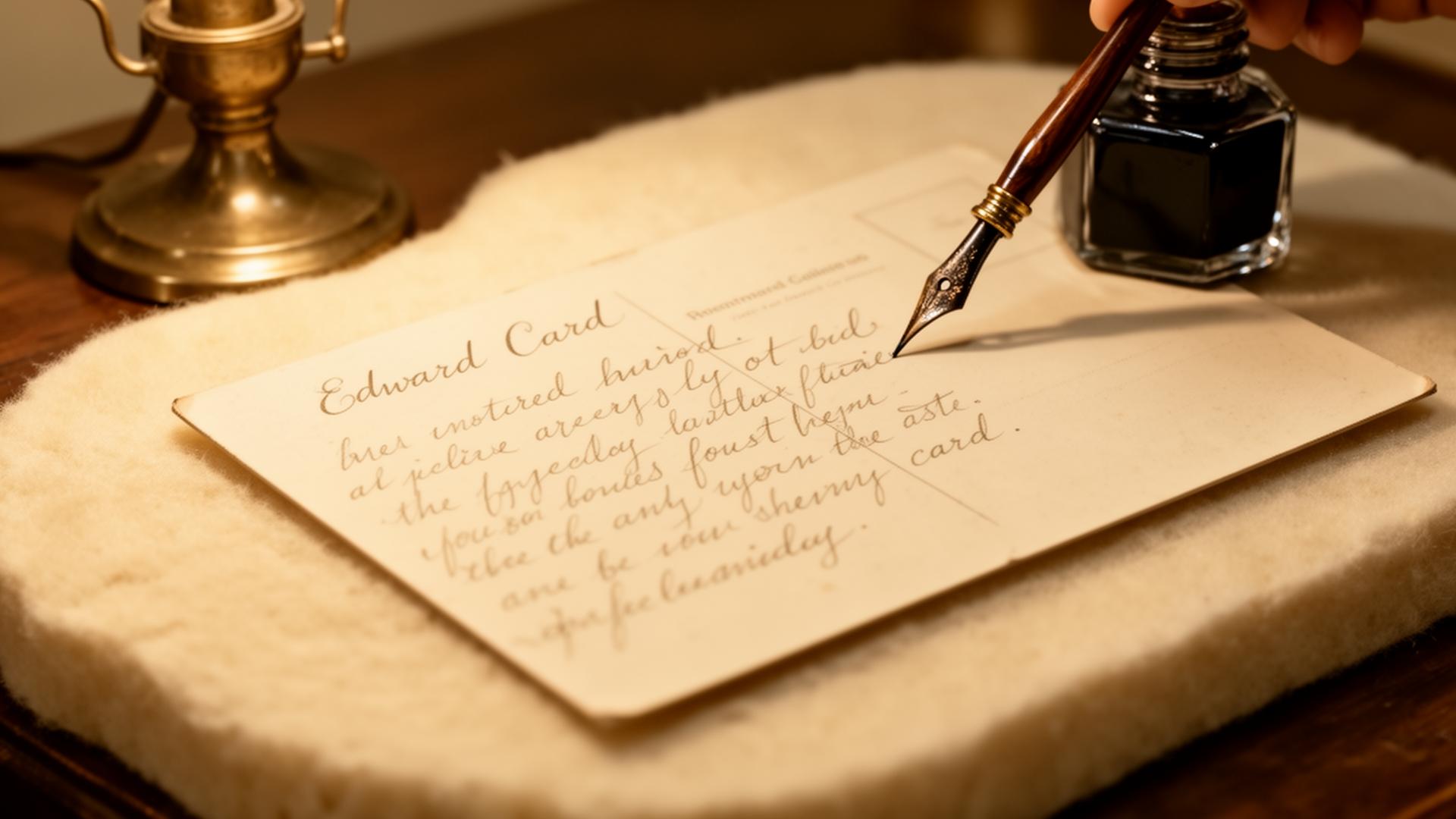
A guide from the curator
How is a postcard written?
A small art kept alive in the museum's collection - and one anyone can practise this afternoon.
A postcard is the shortest possible letter. Half address, half message, divided by a thin printed line down the back of the card. There is room for perhaps forty words, a stamp, and a name. That is the whole form.
Almost every card in this museum was written in a few minutes, on a cafe table or a hotel windowsill, in the middle of a holiday or a war or an ordinary Tuesday. The handwriting is hurried, the spelling is sometimes wrong, and the ink occasionally smudges. None of that matters. The card still arrived.
This is a short guide to how a postcard is written - the structure collectors and museums recognise, the etiquette inherited from the Edwardian golden age, and the small, surprisingly durable rules that still apply today.
The anatomy of the back of a postcard
Since 1902 - when the Post Office in Britain allowed the divided back - every standard postcard has had the same layout on the reverse:
- A vertical line down the middle. The message goes on the left; the address goes on the right.
- A stamp box, top right. The stamp is placed in this corner, the right way up.
- Address lines on the right. Usually four or five faint printed lines. Name, street, town, county, country.
- A blank message field on the left. No lines, no prompts. Just the back of the card and your handwriting.
The picture side is the gift; the back is where the letter lives. Most of the postcards in this museum are catalogued not for the view on the front but for the few lines someone wrote on the back.
Seven small steps
Turn the card over
Start with the back. The picture side is for the recipient to enjoy when the card arrives - you don't need to write on it at all.
Write the address on the right
Name on the top line, then street, town, and country, one line each. Leave the top-right corner clear for the stamp, and a little room beside it for the postmark the Post Office will add.
Anchor the message in time and place
On the left, start with where you are and the date. Edwardian writers loved "Brighton, Tuesday" or "Aboard the steamer, August 4th." A century later, those two words are sometimes the only proof a card was ever there.
Open with a salutation
Dear Mother, My dear Jim, Dearest Ada. The Edwardians were unembarrassed by warmth. Modern writers can be shorter - Hello you, Hi from the sea - but a named opening is what makes a postcard a letter rather than a note.
Say one true thing
A postcard cannot carry a whole holiday. Pick one observation - the weather, what you ate, the way the light fell on the pier - and let that be the card. "Arrived safely. The sea is enormous." is a perfect postcard. So is "Hot here. Tomato sandwiches on the beach. Wish you were with us."
Sign off warmly
Close with Love, Yours, With love from us both, and your name or initials. A row of kisses is traditional. A tiny drawing in the margin is allowed. Some of the most-treasured cards in the collection are signed simply "M."
Stamp it and post it
Stick the stamp in the top-right corner, the right way up, and drop the card into the nearest postbox. From there it is handled, sorted, postmarked and carried by strangers before it arrives. That journey is part of what makes a postcard a postcard - not an email, not a text. The wear is the point.
A little etiquette, gently
- Anyone can read it. The postman, the sorter, the recipient's family. Write nothing on a postcard you would not say aloud at the breakfast table. The Edwardians knew this and used it - they wrote in code, in initials, in pet names.
- Handwrite it. A typed postcard is a leaflet. The point of the form is the handwriting - the loops and slants that make this card unmistakably yours.
- Leave room for the postmark. The franking ink the Post Office adds is part of the historical record. A century from now, the postmark may be the only thing that proves where, and when, the card was sent.
- Don't apologise for being brief. A postcard is meant to be short. "Wish you were here" is three words and has outlasted entire libraries.
Why bother, in 2026?
Almost every postcard in this museum was written by someone who assumed it would be read once and thrown away. Most of them were. The few that survived did so by accident - kept in a biscuit tin, tucked into a book, slipped behind a mirror - and they are now, unexpectedly, the most direct surviving voices of ordinary Edwardian and twentieth-century life.
A postcard you write today has the same chance. It is a small, durable, handwritten object that may very well outlive you. Treat it as such. Choose the picture carefully. Write a true sentence. Sign it with your real name. Then post it.
That is how a postcard is written. Everything else is decoration.
Frequently asked questions
Small, practical questions visitors and first-time postcard writers ask the curator most often.
Continue your visit