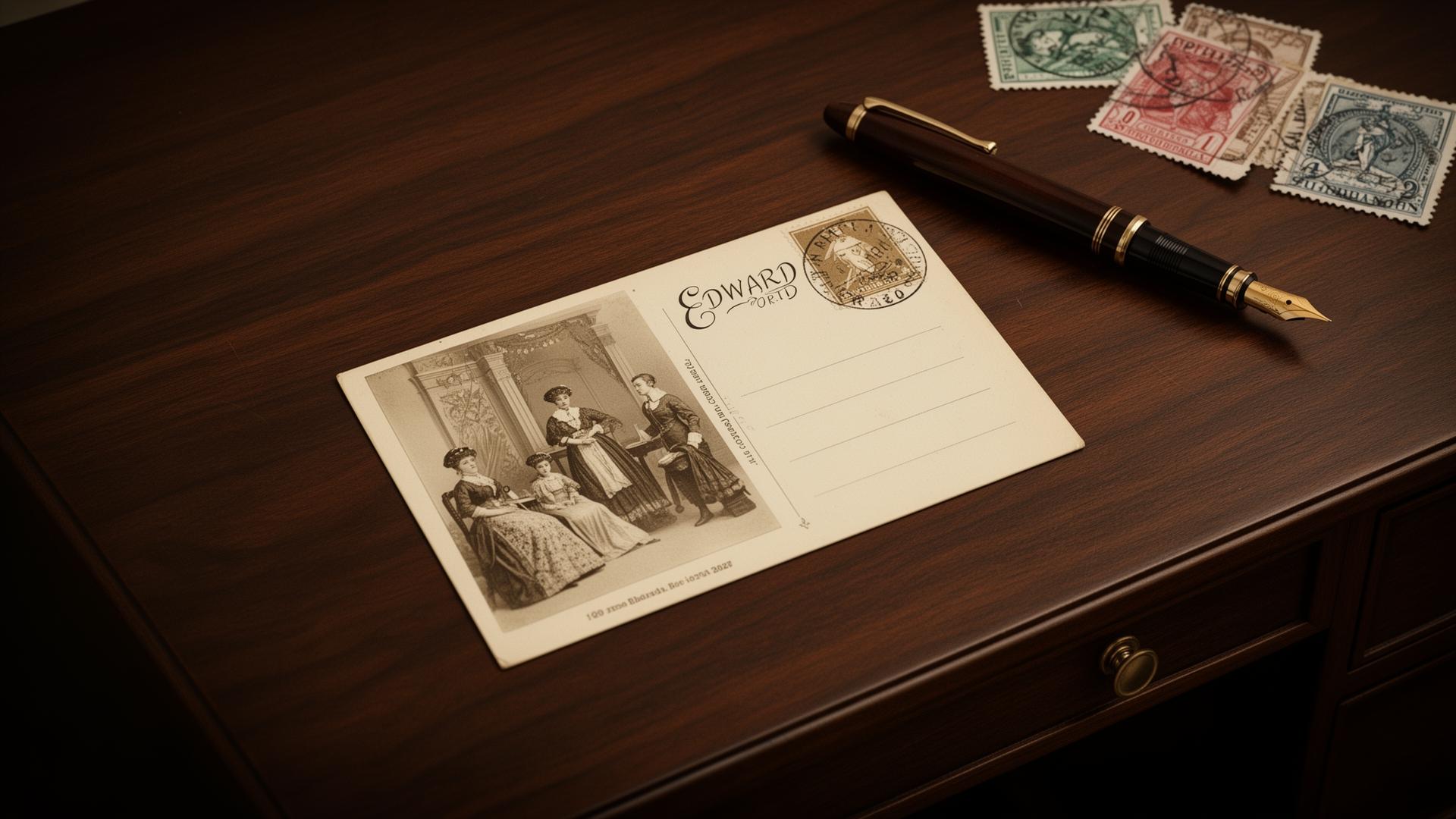
A guide from the curator
Collecting vintage postcards
What they are worth, how to read their age, and how to keep them well.
Almost every postcard in this museum was bought for less than the price of a cup of tea. The interesting work, almost always, is knowing which one to pick up. A century of postcards covers millions of cards, made in many countries, in many printing processes, by people of very uneven talent. Most of them are decoration. A few of them are documents.
This guide is the practical part of the museum: how to date a card, what makes one valuable, and how to display and store the cards you keep so that they last another hundred years.
Are vintage postcards valuable?
The short answer is: a few of them are, and most of them are not - but the few that are can surprise you. A common Edwardian view of a English seafront, in fair condition, used, is worth a pound or two. The same seafront photographed in 1907 by a local photographer and printed on real-photo paper, with the shopfronts visible and the shop names legible, can be worth fifty.
What collectors actually pay for, in rough order of importance, is:
- Subject. Named shops, named people, identifiable streets, disasters, suffragette and political campaigns, early aviation, ships, trains, named artists.
- Process. A real-photo postcard (RPPC) almost always outvalues a printed lithograph of the same subject.
- Condition. No creases, no album corners, no thinning where a stamp was lifted, no faded ink.
- The message. A dated, located, clearly handwritten note adds historical weight; a card signed by, or addressed to, someone identifiable can add a great deal more.
- Postmark and stamp. A rare or early postmark, or a scarce stamp on cover, can outvalue the card it is stuck to.
How to date a postcard
Pick the card up and turn it over. The back tells you more than the front.
- Undivided back, address only. The card is almost certainly pre-1902 in the UK and pre-1907 in the US. The message would have had to share the picture side.
- Divided back, no white border on the front. Roughly 1902 to 1915 - the Edwardian "golden age" of the picture postcard.
- Divided back, white border on the front. Roughly 1915 to 1930.
- "Linen" texture, vivid colours. 1930s and 1940s, particularly American.
- Glossy photographic chrome. 1939 onwards, the dominant style by the 1960s.
Then the postmark: if the card was posted, you have the exact day. Then the stamp: monarch, denomination and design narrow the window further. Then the publisher's imprint on the back - Raphael Tuck, Valentine's, Bamforth, Photochrom - which often carries a serial number that ties to a known publication year.
Displaying postcards
A postcard wants to be seen from both sides. That is the small puzzle of displaying them: the picture is the gift, but the message is the document, and a frame that hides one half halves the card. Three approaches the museum uses, in order of how much wall space you have.
- The hinged mat. A double-sided window mat that shows the front, with a flap behind the card so the back can be turned over and read. The most card-respectful option.
- The pair frame. A single frame with two windows, front and back of the same card mounted side by side. Less subtle, but you read the whole card at once.
- The shallow shadow box. Best for groups - a row of cards from one place, or one correspondent, or one year. The mass of small handwritten objects is what carries the wall.
Hang any of them away from direct sunlight and away from heat. Photographic surfaces fade faster than printed ones, and a century-old card with three years of strong south-facing sun on it is no longer the same card.
Framing without damage
The single rule is: nothing adhesive ever touches the card. No tape, no glue dots, no mounting putty, no self-adhesive album page. All of them will yellow the paper, transfer to the back, and reduce the card's value to nothing within a decade.
The museum's standard frame, in plain language:
- Acid-free backing board.
- An acid-free window mat, cut slightly smaller than the card so the card sits behind the window rather than in front of it.
- Acid-free photo corners, or a clear archival Mylar sleeve, to hold the card in place against the backing.
- UV-filtering glass for anything you care about.
- A frame deep enough that the glass never touches the card surface.
Done this way the card is reversible: you can lift it out tomorrow, undamaged, and put it back in a sleeve.
Storing the rest
Most of a collection lives in a box, not on a wall. Use an acid-free archival storage box and stand the cards upright, like books, divided by acid-free card dividers by country, year or theme - whichever way you actually want to find them.
For working access, polypropylene sleeves in a postcard binder are excellent: you can read both sides without ever touching the card surface. Avoid PVC sleeves, rubber bands, paper clips and old self-adhesive albums - all four are silent destroyers of paper.
Frequently asked questions
The questions visitors send the museum most often about value, age, display and care.
Continue your visit